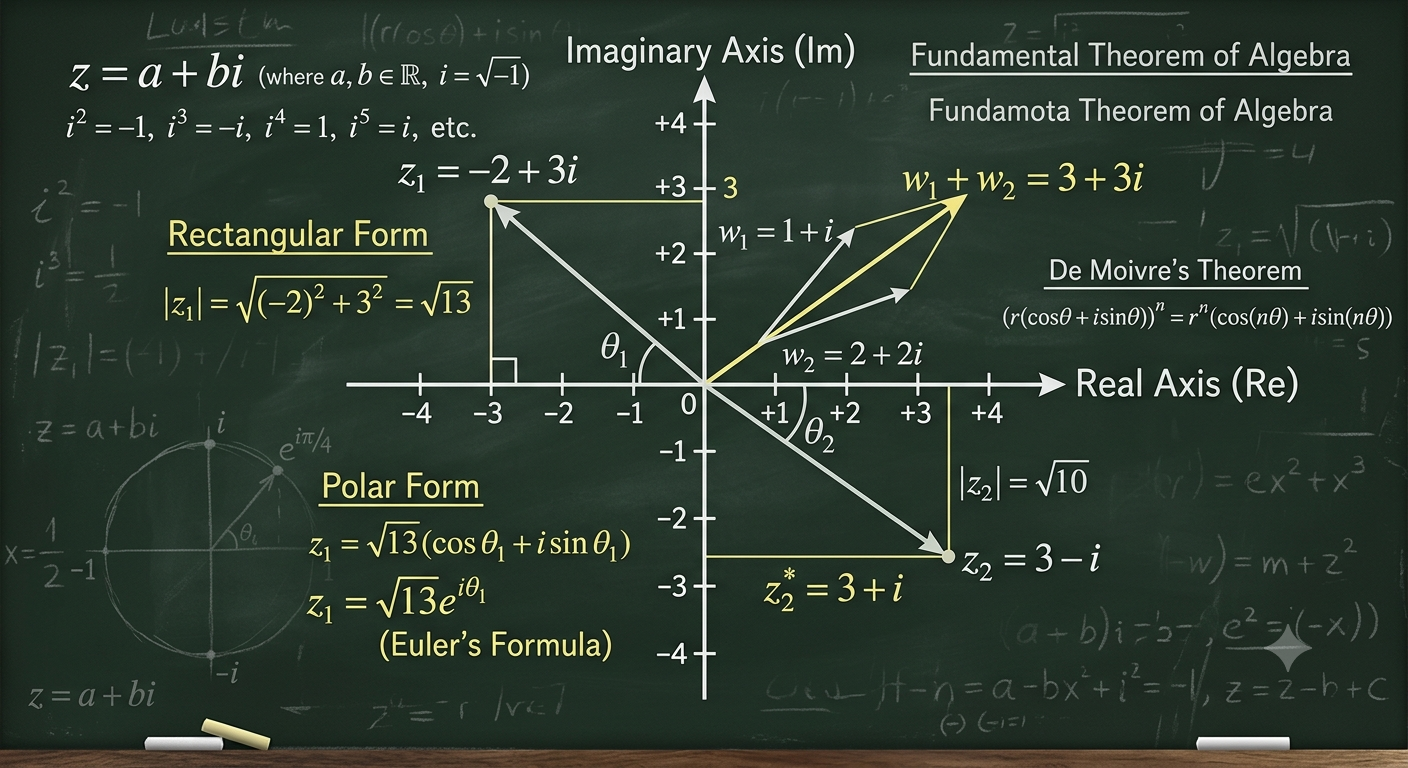
Welcome to Complex Numbers. This course introduces one of the most important extensions of the number system in mathematics. Complex numbers allow us to solve equations that have no real-number solutions and provide powerful tools used in engineering, physics, computer science, economics, and advanced mathematics.
Throughout this course, you will develop a solid understanding of complex numbers, learn how to perform operations with them, and explore their geometric and practical applications.
Course Objectives
By the end of this course, learners should be able to:
1.Define and interpret complex numbers.
2. Identify the real and imaginary parts of a complex number.
3. Perform addition, subtraction, multiplication, and division of complex numbers.
4.Simplify expressions involving the imaginary unit i
5.Represent complex numbers on the Argand (complex) plane.
6.Determine the modulus and argument of a complex number.
7.Convert between rectangular and polar forms.
8.Apply De Moivre’s Theorem to powers and roots of complex numbers.
9.Solve mathematical problems involving complex numbers in various contexts.
SUGGESTED LEARNING RESOURCES
a)Textbooks and Reference Materials
Stewart, J., Redlin, L., & Watson, S. (2015). Precalculus: Mathematics for calculus (7th ed.). Cengage Learning.
Sullivan, M. (2020). Algebra and trigonometry (11th ed.). Pearson.
Kreyszig, E. (2011). Advanced engineering mathematics (10th ed.). Wiley.
Brown, J. W., & Churchill, R. V. (2014). Complex variables and applications (9th ed.). McGraw-Hill Education.
b)Online Learning Platforms
- Khan Academy – Free lessons, videos, and exercises on complex numbers and related algebra topics.
- Paul's Online Math Notes – Detailed notes and practice problems covering complex numbers and algebra.
- OpenStax Mathematics Resources – Free, peer-reviewed mathematics textbooks.
Modules
Module 1: Introduction to Complex Numbers
(i) The need for complex numbers.
(ii) The imaginary unit i.
(iii) Standard form a+bi.
(iv) Real and imaginary components.
Module 2: Operations with Complex Numbers
(i)Addition and subtraction.
(ii)Multiplication.
(iii)Division using complex conjugates.
(iv)Powers of i.
Module 3: Graphical Representation
(i)The complex plane.
(ii)Plotting complex numbers.
(iii)Distance from the origin.
(iv)Geometric interpretation of operations.
Module 4: Polar Form, Modulus and advanced applications
(i)Modulus of a complex number.
(ii)Argument and angle measurement.
(iii)Conversion between rectangular and polar forms.
(iv)Trigonometric representation.
- Teacher: Kithinji Trainer